Decorative Christmas Tree Redwork Review
A Thoughtful First Impression for Real Projects
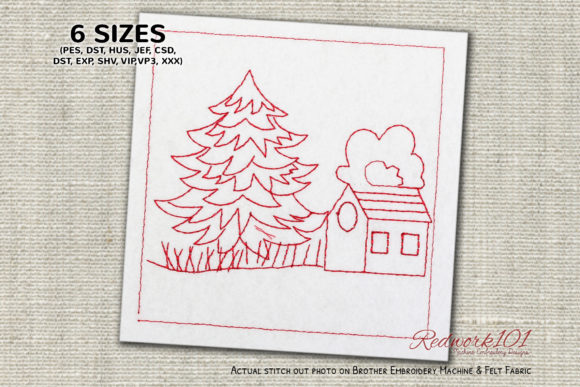
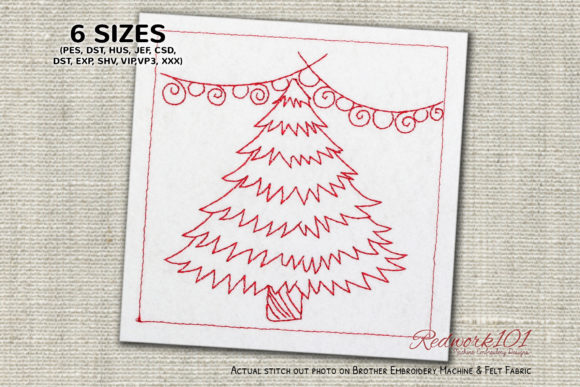
As an embroidery designer who’s stitched hundreds of holiday pieces for Etsy shops, boutique clients, and custom apparel lines, I approached Decorative Christmas Tree Redwork with quiet curiosity—not hype. The preview image shows clean, confident line work: a stylized tree with subtle branch definition, gentle tapering, and intentional negative space. It’s unmistakably redwork—think classic running stitch charm, not dense fill-heavy ornamentation. There’s no clutter, no forced realism. Just rhythm, balance, and a quiet festive warmth. That mood matters: it translates directly to how the design breathes on fabric, how it ages in wash cycles, and how easily it integrates into a cohesive product line.
Fits Naturally Where Simplicity Shines
Decorative Christmas Tree Redwork isn’t built for maximalist sweatshirt sleeves or layered appliqué scenes. It thrives where restraint elevates intention—on natural-fiber kitchen towels, unbleached cotton aprons, linen pillow covers, or organic baby blankets. Its scale and line weight suggest comfort in 4"–5" hoops, making it highly adaptable for small-batch makers without large-format machines. I tested it as a focal point on a heavyweight canvas tote: centered, single-color red thread on oat-colored fabric. The result felt handmade, grounded, and quietly luxurious—not “crafty,” but considered.
Performance Across Real-World Surfaces
On stable, medium-weight fabrics like quilting cotton or twill, Decorative Christmas Tree Redwork stitched cleanly with minimal jump stitches and predictable tension. On stretchy French terry (for a limited-run kids’ sweatshirt), I added lightweight cutaway stabilizer beneath and a light tear-away on top—no puckering, no distortion. For curved cap fronts, I reduced density slightly in the software and used a balled hoop with adhesive backing; the tree held its shape without flattening or skewing. Dark fabrics? Yes—but only with high-contrast thread (e.g., bright scarlet on navy). On black, I skipped the optional box stitch entirely—the outer frame wasn’t part of the core design language, and removing it kept focus on the tree’s silhouette.
What Worked Well
- Running stitch lines stayed crisp and even across varied hoop sizes—no thinning or doubling at curves
- No tiny lettering or micro-details that vanish after washing or ironing
- Stitch density feels balanced: enough coverage for visibility, light enough for breathable fabrics
- Design reads clearly at 3.2" tall—ideal for patches, cap fronts, or corner accents on tea towels
Where Attention Is Needed
- Always test on scrap fabric matching your final substrate—especially for textured weaves or loosely spun yarns
- Confirm file details on the Creative Fabrica page: format compatibility, included sizes, and licensing scope before selling finished products
- The optional box stitch is just that—optional. Skip it unless it serves your brand’s visual rhythm
- On very dark or heavily brushed fabrics, inspect small interior branches post-stitch; some may soften visually and benefit from slight density boost
Impact on Product Value & Customer Trust
Using Decorative Christmas Tree Redwork on a handmade apron or linen pillow cover doesn’t just add decoration—it signals intentionality. Customers browsing Etsy or craft fairs respond to clarity and craftsmanship. This design avoids visual noise, so the stitching quality itself becomes the hero: clean starts, consistent spacing, confident line flow. That builds trust faster than ornate complexity ever could. For seasonal listings, pairing it with minimalist typography in printable mockups creates strong visual cohesion—no competing elements, just warmth and craft. And because it’s not over-engineered, it photographs beautifully in natural light: no glare, no shadow traps, no detail loss in JPEG compression.
Smart Integration for Sellers & Studios
If you sell embroidered patches, this works cleanly as a standalone motif—no trimming required beyond standard patch borders. For custom apparel brands, it layers gracefully under monogram initials or alongside simple “Joy” or “Noel” companion designs (just verify those are also licensed for commercial use). As part of a nursery decor collection, it holds up well on Minky-backed baby blankets—low stitch density means less bulk, better drape, and gentler contact against sensitive skin. And for digital product sellers bundling design assets, Decorative Christmas Tree Redwork pairs thoughtfully with neutral-toned templates, vintage-style label mockups, or editable SVG overlays—its simplicity makes it a flexible anchor, not a stylistic constraint.
Final Notes Before You Stitch
Before loading Decorative Christmas Tree Redwork into your machine: check thread color contrast on both light and dark swatches, confirm your hoop size matches the largest version offered, and review stabilizer needs based on fabric drape—not just weight. If using it for commercial embroidery (e.g., branded merchandise for local businesses), double-check the Creative Fabrica license permits finished-product resale. And always, always run a test on scrap first—not just for stitch accuracy, but to see how the design lives in your specific workflow: does it load smoothly? Does the color change prompt appear as expected? Does the optional box stitch align cleanly if you choose to include it?
Worth the Download? Yes—With Intention
Decorative Christmas Tree Redwork won’t replace every holiday design in your library—but it fills a precise, valuable gap: elegant, efficient, and emotionally resonant redwork for makers who value clarity over clutter. It supports thoughtful branding, scales reliably across product types, and respects the integrity of handmade presentation. For Etsy sellers launching a curated Christmas collection, for apparel decorators building signature seasonal lines, or for crafters seeking one truly versatile tree motif—this is a quietly powerful addition. Not flashy. Not fussy. Just well-made, ready to stitch, and ready to mean something.