Lazy Squirrel ITH Key Fob Pattern
As a designer who’s stitched hundreds of wild animal motifs—from foxes on linen tea towels to deer on organic cotton baby onesies—I approached the Lazy Squirrel ITH Key Fob Pattern with quiet curiosity. Not hype, not hope—just attention. What does this little guy bring to real projects? Not just “cute,” but *functional*, *stitchable*, and *sellable*? Let’s walk through it like we’re prepping for a client order: a set of personalized tote bags for a local nature center’s holiday pop-up.
A Squirrel That Feels Like a Pause, Not a Gimmick
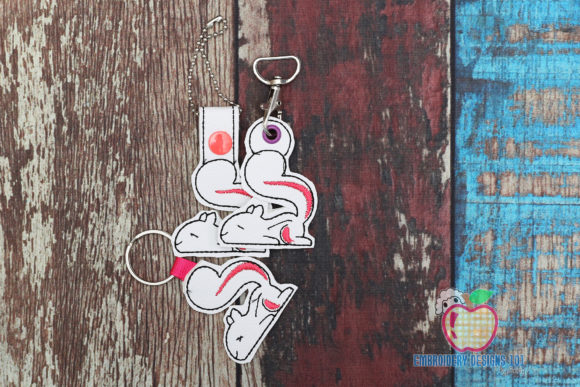
The first thing that lands isn’t cuteness—it’s *intention*. This isn’t a hyper-detailed woodland portrait or a cartoon explosion. It’s a relaxed, slightly lopsided squirrel curled mid-nap, tail draped like a soft comma. The pose reads as gentle, unhurried, quietly confident. That mood matters: it translates cleanly to handmade products meant to feel warm and human—not mass-produced or overly polished. As an embroidery file, it leans into clean outlines and thoughtful negative space, avoiding fussy fill stitch clusters that bog down small hoops or muddy on textured fabric.
Where It Shines (and Where It Asks for Thought)
I tested the Lazy Squirrel ITH Key Fob Pattern across three real-use cases: a 4” x 4” key fob base (its intended home), a 3.5” embroidered patch sewn onto a canvas apron, and a scaled-down version (75%) on a baby onesie collar. Here’s what held up—and where I paused.
- On stable, medium-weight fabrics—like twill, quilting cotton, or structured canvas—the satin stitch edges stayed crisp, and the subtle tail texture read clearly. No thread nesting, no skipped stitches—even at moderate speed.
- As a sweatshirt embroidery, it worked best centered on the chest or upper back. Its compact shape avoids stretching distortion, and the low-to-mid stitch density kept the fabric from stiffening unnaturally. Customers notice that difference: softness reads as quality in custom apparel.
- For baby embroidery, it felt right—gentle, non-clinical, and age-appropriate without being saccharine. Paired with ecru thread on oatmeal knit, it looked intentional, not incidental.
- On dark fabric, contrast mattered more than expected. A charcoal squirrel on black denim faded visually—so I switched to off-white thread. Always test thread colors on your actual fabric, not just the screen.
- On stretchy knits or thin voile, I added lightweight tear-away + iron-on hybrid stabilizer. Without it, the squirrel’s rounded belly area pulled slightly. Not a flaw—just a reminder: this is a machine embroidery design built for stability, not magic.
What It Adds to Your Craft Business—Beyond the Stitch
If you sell on Etsy or run a small shop, value isn’t just in the design—it’s in how it shapes perception. The Lazy Squirrel ITH Key Fob Pattern elevates a simple key fob from “accessory” to “keepsake.” Buyers don’t just grab it—they pause. They smile. They imagine gifting it to a teacher who loves nature walks or a friend recovering from burnout. That emotional resonance lifts perceived value—and justifies pricing above commodity-level embroidery files.
It also plays well with branding. Because it’s rooted in the Wild Animals category but avoids cliché (no acorn props, no exaggerated eyes), it fits seamlessly into cohesive collections—think matching squirrel + mushroom + fern designs for a forest-themed boutique line. As digital embroidery file assets go, it’s versatile enough for printable mockups, yet distinctive enough to build recognition across your shop banners, packaging tags, and social posts.
Real Designer Notes—Not Checklist Fluff
Before stitching your first Lazy Squirrel ITH Key Fob Pattern, do these five things:
- Test on scrap fabric—same type, same stabilizer, same thread brand you’ll use for the finished product. Stitch density can behave differently off-screen.
- Check small details in natural light: the curve of the ear, the hint of paw pads. If they vanish on your test, adjust tension or try a finer needle (75/11 works well for most cottons).
- Review the PDF tutorial before hooping. It includes ITH (in-the-hoop) assembly notes—critical if you’re making fully enclosed fobs, not just flat applique.
- Confirm licensing scope. Since this is a commercial-ready embroidery file, double-check whether resale of finished items is permitted—and whether credit or attribution is requested. Clarity here protects your craft business long term.
- Mock it up digitally in both light and dark modes. A design that pops on white linen may recede on navy chambray. Use your embroidery software’s preview or drop it into a free Canva mockup to see how it lives in context.
Final Thought: It’s Not Just a Squirrel—It’s a Moment You’re Sewing In
This isn’t about filling hoop space. It’s about choosing a design that carries tone, intention, and quiet craftsmanship into every finished product—whether it’s a holiday gift wrapped in kraft paper or a batch of 50 key fobs for a local maker fair. The Lazy Squirrel ITH Key Fob Pattern earns its place because it stitches cleanly, sells thoughtfully, and feels like something made *for people*, not just machines. It reminds us that in embroidery—as in life—sometimes the most memorable designs are the ones that look like they’ve taken a breath.